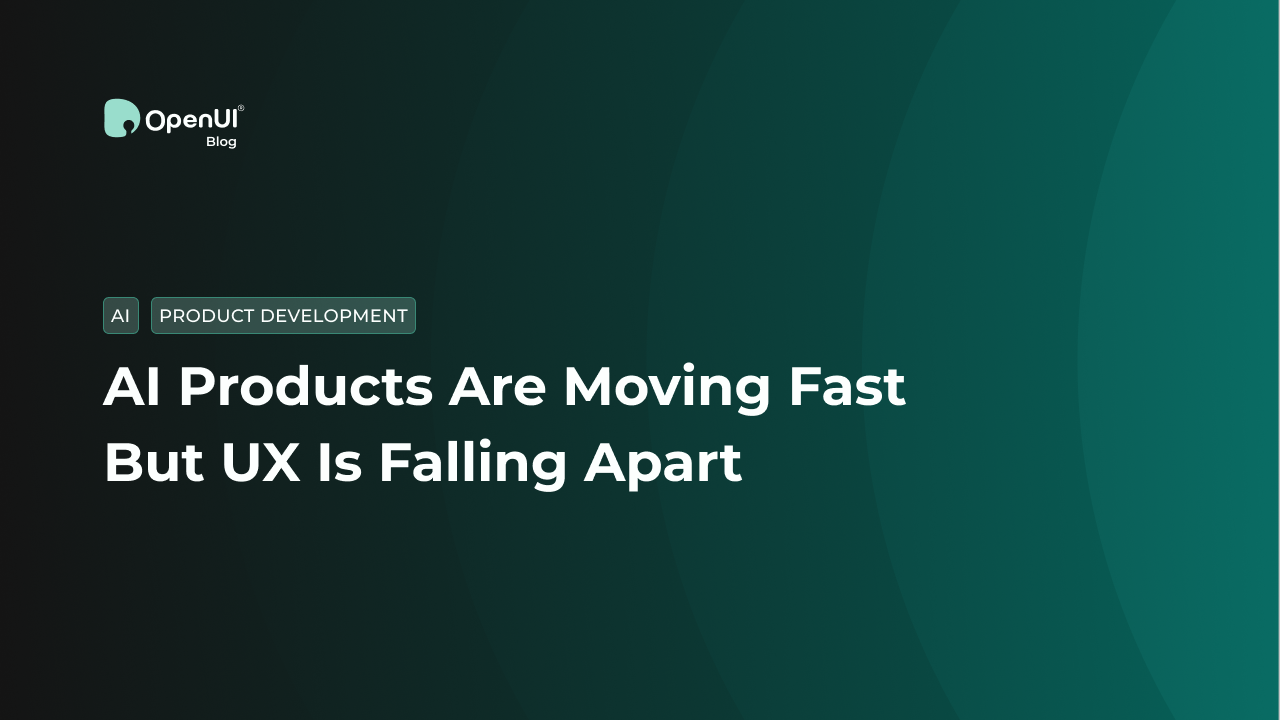



AI Product Architecture: Why Most AI Apps Fail Before Users Notice
The whiteboard was already full before anyone mentioned users. Boxes connected to other boxes. Retrieval pipelines. Vector databases. Memory layers....
July 3, 2026, Aditya Kumar Raj
May 22, 2026, 10:45 am Alok Kumar

Most startup products do not fail because the original idea was weak.
They fail because the product gradually stops reflecting the clarity of the original insight.
At the beginning, the problem usually feels obvious. A founder notices a broken workflow, an underserved market, an operational inefficiency, or a behavioral shift that existing software handles poorly. The early conversations are sharp. The product vision feels coherent. The value proposition is easy to explain.
Then execution begins.
Features get added. Investor expectations evolve. User requests accumulate. Competitors release adjacent functionality. Engineering constraints emerge. AI capabilities expand. Internal teams optimize for speed. Product decisions become increasingly reactive.
Six months later, the product technically does more than it originally did.
Yet somehow it feels less clear.
This is one of the most common reasons great startup ideas still become bad products. The issue is rarely ambition or technical capability alone. More often, the product loses operational coherence while scaling.
And once that happens, even strong ideas become difficult for users to trust, adopt, or understand consistently.
The hardest part of product development is rarely ideation.
It is translation.
The translation from:
- business insight to workflow
- workflow to UX
- UX to engineering systems
- engineering systems to real user behavior
This is where startup product execution becomes fragile.
Founders frequently assume that if the original insight is strong enough, the product will naturally evolve in the right direction. In reality, software products are shaped through hundreds of smaller operational decisions that either reinforce or weaken the original clarity.
Questions like:
- What should the user see first?
- Which actions deserve emphasis?
- What should happen automatically?
- Where should the product remain opinionated?
- Which workflows need simplification?
- What level of flexibility actually helps users?
- What assumptions are users making unconsciously?
These decisions seem small individually.
Collectively, they determine whether a product feels intuitive or exhausting.
Strong startup ideas rarely collapse suddenly. Most products deteriorate gradually through unresolved workflow decisions accumulating over time.
One of the most common execution mistakes inside startups is assuming that feature expansion equals product progress.
This pattern appears constantly across SaaS and AI products.
The team launches an early version. Feedback arrives quickly. Customers request edge cases. Sales teams ask for flexibility. Investors want differentiation. Competitors release overlapping features.
The natural response is to keep adding.
More dashboards.
More permissions.
More AI automation.
More integrations.
More workflows.
More customization.
At first, this appears productive.
But over time, the product starts growing horizontally faster than the workflow architecture underneath it.
The result is software that feels increasingly difficult to navigate despite becoming more technically capable.
This problem usually reveals itself through user behavior long before teams notice it internally.Users hesitate more frequently. Onboarding requires explanation. Support requests repeat similar themes. Teams rely on demos instead of intuitive adoption. Product training expands unnecessarily.
The issue is not simply “too many features.
”The deeper problem is unclear prioritization logic.
Users can no longer easily understand:
- what matters most
- what actions are primary
- how workflows connect
- which decisions carry consequences
- what the system expects from them
The interface becomes crowded because the product thinking underneath it became crowded first.
Many startup teams move into development before the workflow itself is properly understood.
This is especially common among founders under pressure to launch quickly.
The assumption is understandable. Shipping feels like momentum. Investors want traction. Competitors appear active. AI-assisted development makes execution faster than ever.
But speed creates a subtle trap.
Teams begin optimizing for visible progress before validating operational clarity.
The MVP gets scoped around features instead of user outcomes.
This usually produces products that technically function but operationally struggle once real users arrive.
A typical pattern looks like this:
The distinction matters because users rarely evaluate products based on how many features exist.
They evaluate products based on how naturally the workflow fits into real behavior.
A thoughtful MVP is not merely the smallest possible product.
It is the smallest coherent product capable of producing a reliable outcome for users.
That requires product thinking before aggressive execution begins.
AI startups are currently amplifying many of these problems.
Not because AI itself is flawed, but because implementation speed is now outpacing product reasoning inside many teams.
Modern tooling allows startups to generate:
- interfaces
- backend logic
- automation flows
- copilots
- integrations
- conversational systems
extremely quickly.
This creates an illusion of product maturity.
A product may appear advanced in demos while still lacking:
- workflow coherence
- onboarding clarity
- trust signals
- predictable operational behavior
- scalable information architecture
Many AI products today feel impressive technically but mentally exhausting operationally.
Users are forced to interpret too much:
- What is the system doing?
- Why did this output appear?
- Can the result be trusted?
- What happens if the AI is wrong?
- Which actions are reversible?
- Where does user control actually exist?
These are not purely UX concerns.
They are product execution problems.
And they increasingly determine whether users adopt the product confidently or abandon it despite strong technical capability.
One of the clearest patterns among strong product teams is restraint.
Not lack of ambition.Operational restraint.
The best products often feel simpler than the effort required to build them. This usually happens because the team protects workflow clarity aggressively while the product scales.
Strong teams understand that every feature introduces:
- cognitive cost
- operational complexity
- onboarding implications
- engineering maintenance
- UX dependencies
- future architectural consequences
As a result, they spend more time evaluating:
- whether a feature should exist
- how it affects existing workflows
- what user behavior it encourages
- whether it introduces unnecessary decisions
This is where product thinking becomes a competitive advantage.
Because as software generation becomes easier, coherence becomes harder to maintain.
And users rarely reward products for how much functionality exists.
They reward products that reduce friction quietly.
Weak product teams often think in pages and features.
Strong product teams think in systems.
They understand that product quality emerges from the relationship between:
- workflows
- engineering decisions
- information architecture
- user psychology
- operational constraints
- scalability requirements
- business incentives
This systems-level thinking is what separates products that scale sustainably from products that slowly accumulate UX debt and operational inconsistency.
It also changes how teams collaborate internally.
Engineering stops functioning as isolated implementation.
UX stops functioning as surface-level polish.
Product strategy stops existing only inside roadmap documents.
Instead, the product evolves as a coherent operational system.
That alignment becomes increasingly important as products grow more complex - especially in AI-native environments where technical capability expands faster than user comprehension.
Startup culture tends to romanticize speed, shipping velocity, and feature momentum.
Those things matter.But sustainable product quality usually comes from something quieter:clarity.
The companies that build durable products are rarely the ones adding functionality most aggressively. More often, they are the teams protecting workflow coherence while complexity increases.
Because users do not experience startup ambition directly.
They experience friction.
They experience confusion.
They experience confidence.
They experience usability.
And products succeed when those experiences feel intentional rather than accidental.
For founders navigating MVP execution, AI product complexity, or scaling-stage UX inconsistency, discussing the workflow before expanding the feature set often prevents expensive rebuilding later. Teams looking to align product thinking with engineering execution can connect with OpenUI

4th floor, Specturm Tower, Mindspace,
Malad (W), Mumbai, Maharashtra
India - 400064






© OpenUI 2025 - 2026
© OpenUI 2025 - 2026